
Detailed Explanation of Main Control Modes for Tapping Spindle Heads
In automated mass thread machining, the tapping spindle head (tapping power head) is the core unit that determines thread precision, tap wear and production efficiency. Different working conditions, budgets and precision requirements correspond to distinct control solutions. Three mainstream types are widely available on the market: mechanical lead screw synchronous control, single-servo follow rigid tapping, and dual-servo electronic gear synchronous control. This article elaborates on the principles, pros & cons and applicable scenarios of each control method to help manufacturing customers select suitable tapping power heads.
1. Mechanical Lead Screw Synchronous Control (Traditional Pneumatic / Motor Tapping Head)
Control Principle
It relies on internal fixed lead screws and gear ratios to realize linkage between spindle rotation and feed movement. When the spindle rotates, the lead screw simultaneously drives the spindle for linear feed. The lead screw features a fixed pitch, meaning matching lead screws must be replaced to machine threads of different specifications. This is a purely mechanical forced synchronization structure, mostly paired with ordinary asynchronous motors and air cylinder feeding.
Operation Logic
The motor drives spindle rotation and simultaneously actuates the internal lead screw. The screw nut converts rotary motion into linear feed. After tapping completes, the air cylinder retracts the tool quickly. Spindle speed and feed rate are locked together without independent adjustment. Synchronization accuracy fully depends on machining tolerances of gears and lead screws.
Advantages
Low equipment cost, simple control logic, no need for supporting servo controllers, and low barriers for wiring & commissioning. Ideal for rough shallow thread machining with low precision requirements and semi-automatic single machines with few product changeovers.
Disadvantages
1. Single fixed pitch; disassembly and lead screw replacement are required to switch thread specifications, leading to long model change time.
2. Large mechanical clearance causes significant synchronization errors during high-speed machining, and taps are prone to breakage in deep-hole tapping.
3. Rotational speed and feed are locked, disallowing peck tapping by layers.
4. Lead screws suffer long-term wear, resulting in continuous decline of thread yield rate and frequent maintenance.
Applicable Scenarios
Shallow rough thread machining for small hardware and plastic parts, low-budget semi-automatic single machines, and production lines with infrequent product switching.
2. Single-Servo Follow Rigid Tapping Control (CNC Matched Tapping Spindle)
Control Principle
Only the feed axis is equipped with a servo motor, while the spindle uses a variable frequency motor. A high-precision encoder mounted at the spindle tail captures real-time rotation angles. The CNC system calculates feed speed based on spindle speed to achieve follow synchronization: one spindle rotation corresponds to one pitch of feed movement, also known as single-axis rigid tapping control.
Operation Logic
The encoder continuously feeds back the actual spindle rotation angle, and the servo feed axis conducts real-time follow-up compensation to dynamically correct synchronization errors. Thread pitch can be modified directly via parameters without mechanical part replacement, supporting layered peck tapping and segmented variable speed.
Advantages
1. Pitch is set via parameters; switching specifications only requires modifying system parameters for fast model changeover.
2. Synchronization accuracy is greatly improved compared with mechanical synchronization, supporting medium & high-speed tapping.
3. More compact structure than dual-servo solutions with moderate procurement & renovation costs, compatible with ordinary CNC equipment and PLC automated production lines.
Disadvantages
1. Variable frequency spindle delivers weak low-speed torque, prone to slipping and step loss during deep-hole tapping of stainless steel and thick steel plates.
2. Minor delay exists in follow-up, creating precision bottlenecks for ultra-precision fine threads and micro-threads.
3. Spindle rotation and feed cannot be fully independently adjusted, leaving limited space for complex process tuning.
Applicable Scenarios
Matching machining centers, standard thread machining of aluminum & copper workpieces, and medium-precision automated assembly lines.
3. Dual-Servo Electronic Gear Synchronous Control (Mainstream Solution for High-Precision Tapping Spindle Heads)
Control Principle
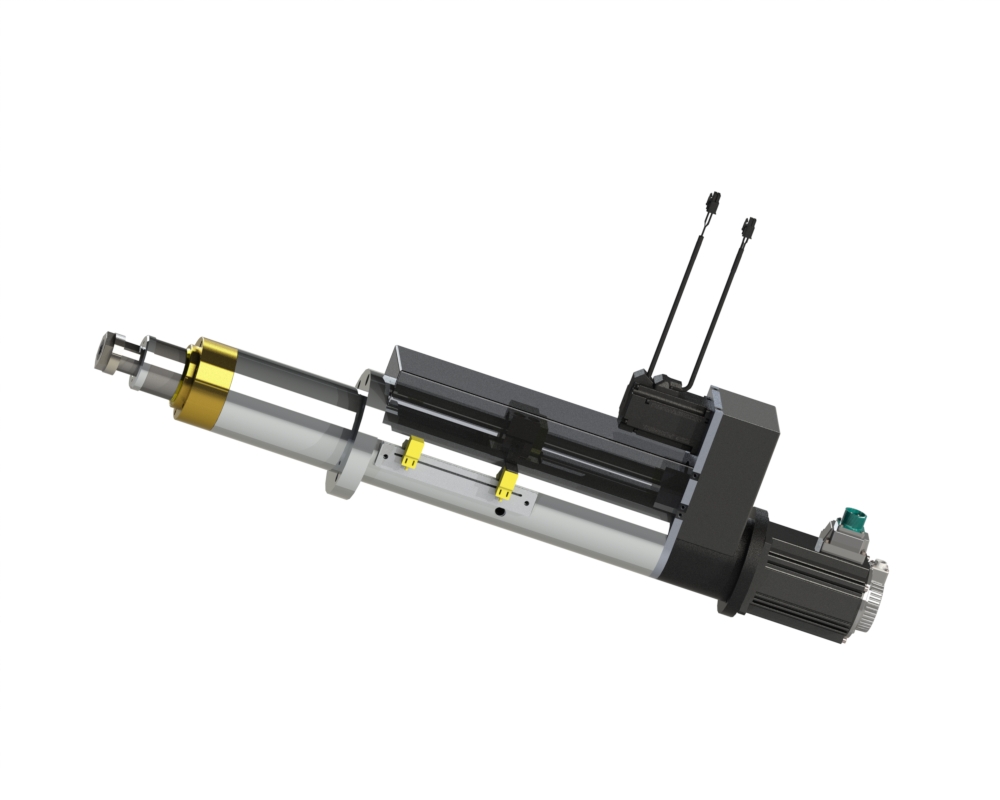
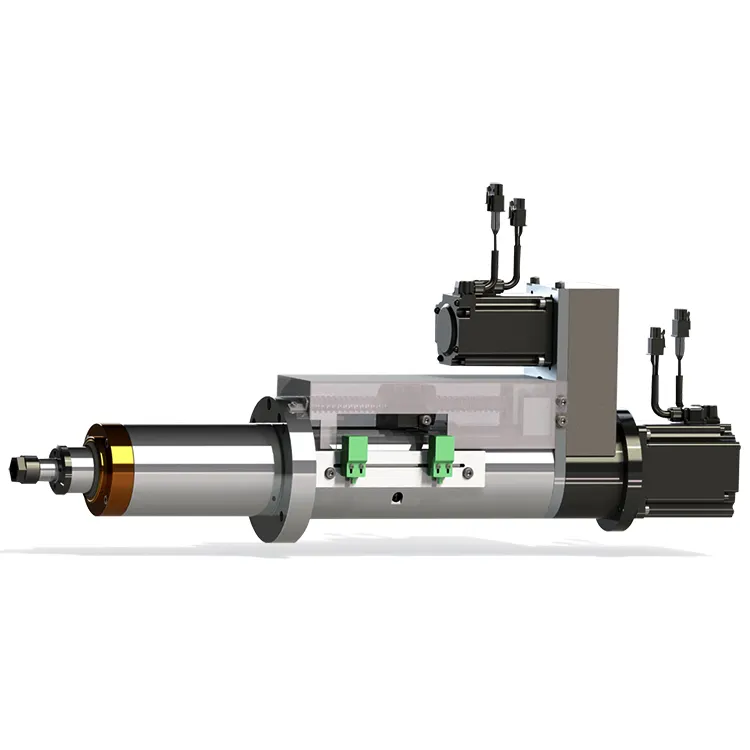
The tapping spindle head integrates two independent servo motors: one dedicated to spindle rotation drive, the other for ball screw linear feed control. The motion controller activates electronic gear synchronization mode. The two servos interact in full closed-loop via encoders to strictly lock the proportional relationship between spindle rotation angle and feed displacement (1 spindle rotation = feed of 1 thread pitch). Rotation and feed can be fully and independently regulated, making this the optimal control scheme for precision tapping at present.
Complete Workflow
1. Fast Approach: The feed servo moves at high speed to bring the tap close to the workpiece.
2. Synchronous Tapping: Electronic gears lock the synchronization ratio for synchronized spindle rotation and feed; segmented low-speed cutting torque can be configured.
3. Depth Stop: Both axes decelerate and stop simultaneously upon reaching target depth to avoid over-cutting.
4. Synchronous Retraction: The spindle reverses rotation while the feed retracts synchronously with zero phase difference throughout the process.
5. Fast Reset: The feed axis returns to the origin at high speed for the next process cycle.
Core Control Advantages
1. Ultra-high synchronization accuracy: Full closed-loop dual encoders with dynamic synchronization error ≤0.001mm, eliminating incomplete threads and broken taps for micro fine threads, automotive precision threads and PCB stud threads.
2. Decoupled speed & feed control: Spindle rotational speed and feed rate are infinitely adjustable independently, with exclusive cutting parameters configurable for soft aluminum, stainless steel and cast iron.
3. Supports intelligent peck tapping, segmented variable speed and torque overload early warning, extending tap service life by over 50%.
4. One-click storage of parameters for one-switch program switching of multiple thread specifications, compatible with flexible production lines with frequent product changes.
5. Built-in alarms for servo overload, stalling and over-travel, featuring strong compatibility with robots and fully automatic assembly lines.
Disadvantages
Higher overall procurement cost than mechanical and single-servo solutions; supporting servo drives and motion controllers are required, and professional technicians are needed for initial commissioning.
Applicable Scenarios
High-precision mass production lines for auto parts, new energy housings, motorcycle components, precision molds and PCB micro-hole tapping, as well as robot-linked tapping operations. This is also the standard tapping spindle control scheme for high-end automated equipment.
4. Comparison Summary of Three Control Modes for Selection
1. Low-cost demand & single-spec shallow-hole machining: Choose mechanical lead screw tapping spindle head.
2. Balanced cost & precision, standard aluminum/copper CNC machining: Select single-servo follow rigid tapping spindle.
3. High precision, multi-product production, deep-hole/fine thread processing, robot linkage and 24-hour non-stop mass production: Prioritize dual-servo electronic gear synchronous tapping spindle head.
5. Supporting Extended Control Systems for Tapping Spindles
1. PLC Touch Screen Control: Visual parameter setting including thread pitch, rotational speed, depth and peck tapping cycles.
2. Robot Linked Control: Dual-servo tapping spindles can directly connect with ABB, Yaskawa and other manipulators for real-time signal interaction and synchronization.
3. Variable Frequency Control System: Mostly applied to old single-servo and mechanical tapping units, only for simple speed regulation.
4. Special Motion Control Card: Standard configuration for dual-servo tapping heads to realize high-speed electronic gear synchronous operation calculation.
 How to Select the Right YSA Servo Spindle for Your CNC Autom
  YSA BD03 High-Precision Dual Servo Drilling and Tapping Sp
  How to Properly Choose Drill Bits for Drilling Operations wi
  Detailed Explanation of Main Control Modes for Tapping Spin